

Artificial intelligence has become one of the defining technologies in clinical research, but much of the conversation has focused on isolated applications. Organizations have explored AI for automating documentation, accelerating reporting, or assisting with data analysis after studies are underway. While those capabilities can certainly improve efficiency, they represent only a portion of what purpose-built AI can contribute to clinical development.
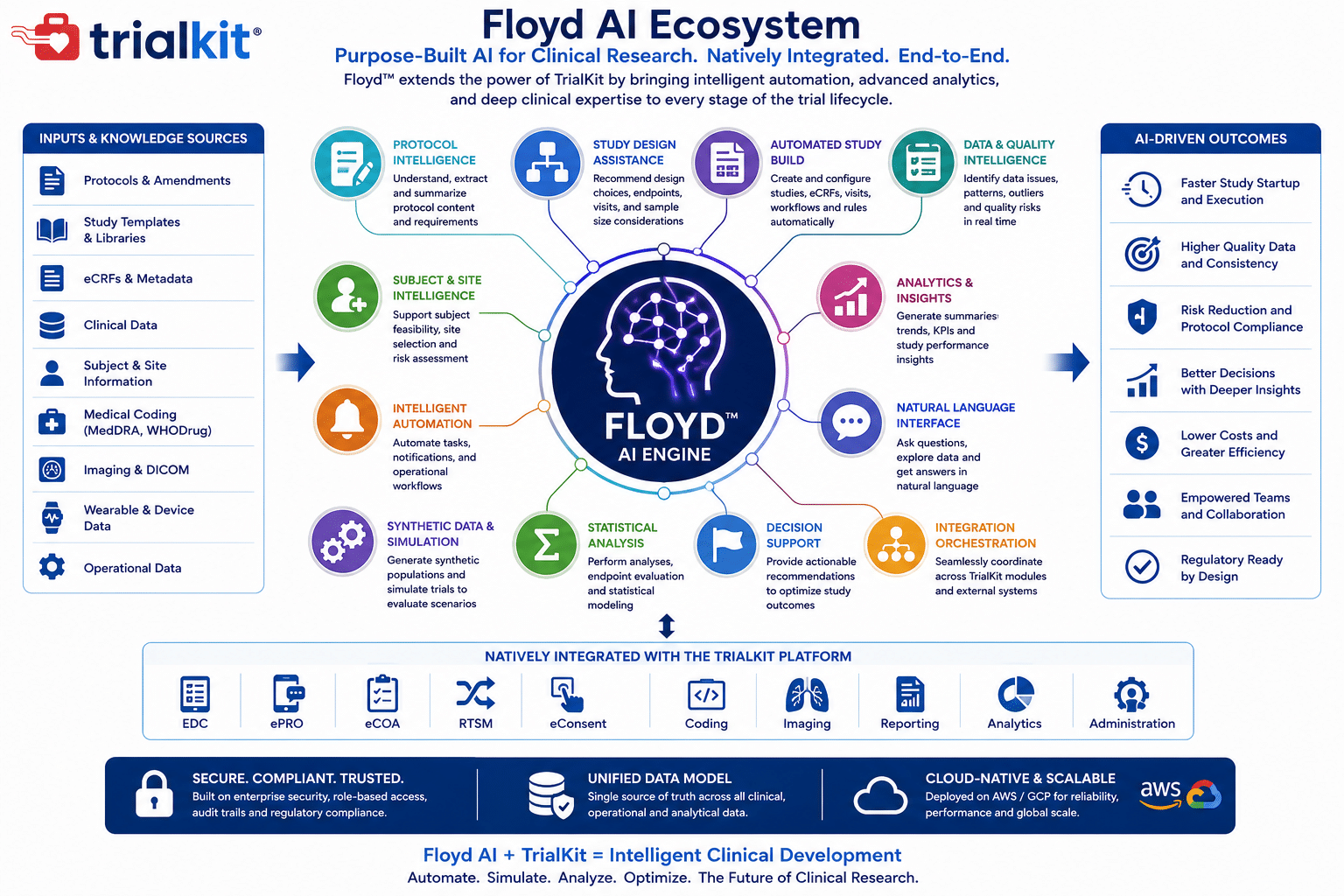
A more significant transformation is emerging earlier in the study lifecycle. Clinical research-focused AI is beginning to support protocol development, study design, database configuration, validation, simulation, and endpoint analysis within a connected environment. Rather than improving a single workflow, AI now has the potential to strengthen every stage of study planning and execution while reducing the manual effort required to move from one phase to the next.
Beginning with the Protocol
Every clinical study begins with a protocol, yet protocols have traditionally been treated as documents that must be interpreted repeatedly by different teams. Clinical operations, data management, programmers, and study builders all review the same information before translating narrative requirements into operational components. This process consumes valuable time and creates opportunities for inconsistencies that may not become apparent until much later in study startup.
Clinical research-focused AI changes that process by treating the protocol as structured knowledge instead of static documentation. Existing protocols can be ingested directly into the platform, while new protocols can be created with AI assistance. Natural language understanding enables the system to identify study objectives, endpoints, eligibility criteria, visit schedules, and workflow requirements, creating a consistent foundation that supports every downstream activity.
Starting with an intelligent understanding of the protocol reduces repeated interpretation and establishes greater continuity throughout the remainder of the study lifecycle.
Designing and Building More Efficient Studies
Once protocol requirements have been established, AI can assist researchers with translating those requirements into an operational study design. Visit schedules, study populations, endpoints, and workflows can be organized within a unified environment that maintains alignment with protocol intent while supporting regulatory expectations.
This continuity becomes especially valuable during study build. Configuring eCRFs, visit schedules, eConsent workflows, eDiaries, and supporting study components has historically required substantial manual effort, often involving multiple specialists working across separate systems. By assisting with these activities directly within TrialKit, AI significantly reduces the time required to move from study concept to a fully configured database while maintaining consistency across study components.
Because every element remains connected to the underlying protocol, updates and refinements can be incorporated much more efficiently than traditional manual workflows.
Improving Study Quality Before Enrollment
Speed alone is not enough to improve clinical research. Study quality must be maintained throughout the build process, particularly before the first participant is enrolled. Validation has therefore become an increasingly important opportunity for AI to provide meaningful value.
Rather than waiting until configuration is complete, TrialKit AI assists with evaluating edit checks, workflow logic, protocol compliance, and data quality rules as part of the overall study development process. Identifying inconsistencies before enrollment begins helps reduce downstream corrections, minimizes operational disruption, and allows research teams to launch studies with greater confidence.
The ability to move from protocol to a validated study in less than ten minutes represents more than an improvement in efficiency. It gives sponsors and CROs additional time to refine study design, evaluate operational assumptions, and focus their expertise where it creates the greatest value.
Simulating Studies Before Patients Participate
Perhaps the most significant advancement in clinical research AI is the ability to evaluate a study before enrolling a single participant. Instead of relying solely on assumptions during study planning, researchers can now generate realistic synthetic participant populations and simulate study execution under a wide range of conditions.
These simulations provide valuable insight into how protocols, workflows, and operational decisions may perform in practice. Study teams can observe participant progression, identify potential bottlenecks, evaluate protocol assumptions, and explore the effects of population variability before those challenges emerge during an active trial.
Depending on study complexity, these simulations can be completed in minutes or hours rather than requiring months of live study execution to reveal the same operational issues. That shift enables sponsors to improve study design while changes remain relatively simple to implement, reducing both cost and operational risk.
Accelerating Analysis and Decision-Making
Rapid access to meaningful insights has always been one of the primary goals of clinical research technology. But traditional reporting workflows often depend on multiple requests, programming cycles, and manual review before study teams receive the information needed to support operational decisions.
Purpose-built AI significantly compresses that timeline by allowing researchers to analyze studies directly against predefined endpoints in less than a minute. Statistical evaluation, endpoint analysis, protocol optimization, and decision support become immediately accessible, allowing study teams to explore findings while maintaining momentum throughout study execution.
Earlier access to reliable information supports faster decision-making, but it also encourages more frequent evaluation. Instead of waiting for scheduled reporting cycles, researchers can continuously assess study performance and respond more quickly as new information becomes available.
Connecting the Entire Clinical Research Lifecycle
The most meaningful contribution of AI is not found within any individual capability, but in the way each stage of the research lifecycle builds upon the one before it. Protocol intelligence informs study design. Study design accelerates database configuration. Validation strengthens study quality before enrollment begins. Synthetic participant simulation allows researchers to evaluate operational assumptions before execution. Endpoint analysis delivers meaningful insight while studies remain active.
Connecting these activities within a single, unified AI-powered environment reduces repeated manual work, improves consistency across study development, and allows information to flow naturally from one phase to the next. As a result, researchers spend less time translating information between disconnected systems and more time applying scientific and operational expertise where it matters most.
Looking Ahead
Clinical research will continue to grow in complexity as protocols become more sophisticated, data sources expand, and development timelines remain under constant pressure. Meeting those demands requires technology that supports the entire research process rather than isolated tasks.
TrialKit AI reflects that broader vision by helping researchers move from protocol development through validated study design, synthetic participant simulation, and endpoint analysis within a unified eClinical platform. The result is a more connected approach to study development that improves efficiency without compromising quality or regulatory rigor. As AI continues to evolve, its greatest contribution may be enabling research teams to rethink how studies are designed, built, and optimized from the very beginning, helping transform research concepts into validated clinical studies in hours instead of years.