Bringing Intelligence Into the Flow of Clinical Trials
How TrialKit AI is changing how studies are designed, run, and understood
Clinical trial teams have never had more data, more tools, or more pressure to move quickly. At the same time, the way most teams work has not fundamentally changed. Study build happens in one system. Data review in another. Analytics in yet another. Insights come later, often too late to meaningfully change outcomes.
That fragmentation has become one of the biggest hidden barriers to speed and quality in clinical research.
Instead of layering intelligence on top of disconnected systems, a new model is emerging, one where intelligence is embedded directly into the same environment where trials are designed, executed, and monitored.
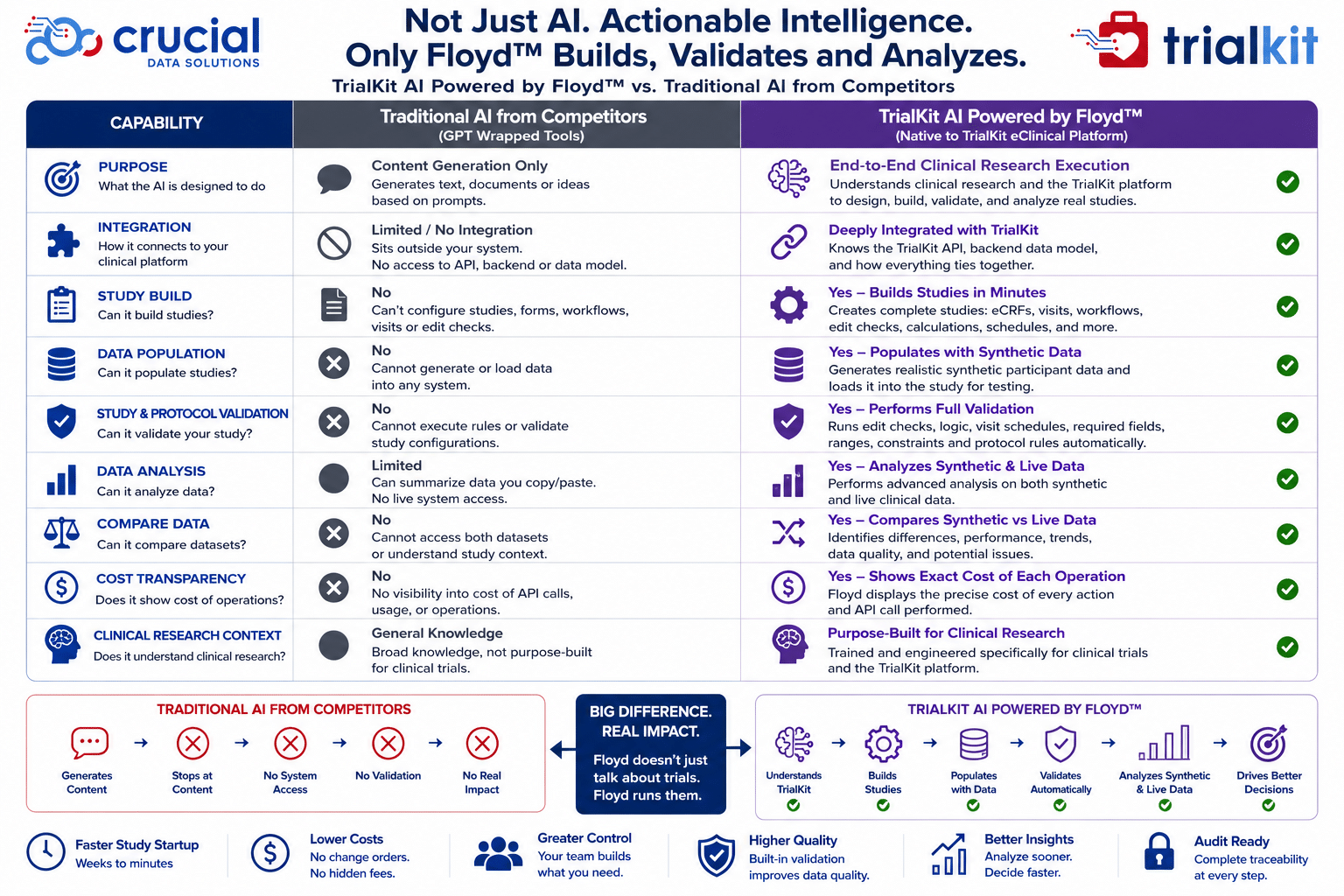
That is the model behind TrialKit, a unified eClinical platform where TrialKit AI brings embedded intelligence into everyday study workflows, powered by Floyd, our proprietary, domain-aware AI model.
A More Connected Way to Work
Most clinical teams are used to working across a patchwork of tools. Even in well-run organizations, there is often a clear separation between:
- Study design and build
- Data capture and cleaning
- Reporting and analytics
Each step introduces friction. Data has to move. Questions take time to answer because the information needed to answer them lives somewhere else.
Crucial Data Solutions approaches this differently by bringing these activities into a single platform. With TrialKit, study teams can create and/or interpret protocols, collect and review data, and explore insights with the help of Floyd, without leaving the system.
The addition of embedded intelligence within this environment changes what teams can do in real time. Instead of exporting data to analyze it, teams can ask questions directly within the platform. Instead of waiting for reports, they can explore trends as they emerge.
That shift sounds subtle, but in practice, it greatly compresses timelines and improves decision-making at every stage of a trial.
From Data Collection to Data Understanding
eClinical systems have traditionally focused on capturing and organizing data. That remains essential, but it is no longer enough.
What teams need today is the ability to understand what the data means while the study is still in motion.
Within TrialKit, intelligence is not treated as a separate layer or add-on. It is built into the same workflows that teams use every day, allowing data to be explored as it is collected rather than after the fact. Teams can examine patterns across visits and timepoints in real time, ask questions as they arise, and follow those questions wherever the data leads without needing to step outside the platform.
Because the system understands the full structure of the study, including forms, fields, visits, and protocol logic, it can interpret data in context rather than as isolated values. This makes a meaningful difference in how quickly and confidently teams can move from observation to insight.
Instead of relying on static dashboards or waiting for predefined reports, interaction with data is more fluid. Questions do not need to be anticipated in advance. They can be asked in natural language and answered in the moment, which supports faster, more informed decisions throughout the course of a study.
Simulating Trials Before They Begin with TrialKit AI
One of the most meaningful capabilities of TrialKit AI is the ability to simulate clinical trials before enrolling a single patient. Rather than relying only on assumptions, historical benchmarks, or static feasibility assessments, teams can explore how a study is likely to behave in a more dynamic and informed way.
This capability is powered by Floyd, which generates realistic, protocol-consistent virtual participants and models how they progress over time within the structure of a given study. Because the system understands the full context of the protocol, including endpoints, visit schedules, and eligibility criteria, these simulations reflect more than simple statistical projections. They mirror how a study might actually unfold. This allows teams to explore how endpoint definitions, eligibility criteria, or operational assumptions may influence study timelines and outcomes.
While these simulations do not replace real-world data, they provide a stronger foundation for the decisions that shape how that data will ultimately be generated. The result is a more thoughtful approach to study design, fewer surprises during execution, and a clearer path toward successful outcomes.
Transparency Matters
Clinical research operates in an environment where decisions must be supported, explained, and trusted. It is not enough to generate insights. Teams need to understand how those insights were derived and be able to stand behind them with confidence.
Through TrialKit AI, interpretability is built into how results are presented and explored. When patterns, predictions, or simulated outcomes are generated, the platform provides context that helps users understand why those results appear as they do. This includes visibility into how data relationships are being interpreted, how trends are forming over time, and what factors may be influencing outliers or unexpected results.
That level of transparency supports more effective decision-making across the study team. Researchers can investigate findings more thoroughly, validate assumptions, and align more easily around next steps. It also strengthens communication with internal stakeholders and external partners, including regulators, where clarity and rationale are essential.
Over time, this approach helps build trust in how insights are generated and used. Rather than treating advanced analytics as a black box, teams can engage with the reasoning behind the results. That makes it easier to adopt new ways of working while maintaining the rigor and accountability that clinical research demands.
Speed Without Compromise
Speed is often discussed in clinical development, but it is frequently framed as a trade-off. Faster timelines can introduce risk. More oversight can slow things down.
What TrialKit demonstrates is that speed and rigor do not have to be in conflict.
By reducing friction between systems and embedding intelligence directly into workflows, teams can:
- Identify issues earlier
- Make decisions faster
- Reduce rework and protocol amendments
- Keep studies moving without sacrificing quality
A Practical Path Forward for Sponsors and CROs
For sponsors and CROs, the challenge is not whether to adopt new capabilities, but how to do so without disrupting ongoing work or adding unnecessary complexity. Technology only delivers value when it fits into the realities of how studies are actually run.
TrialKit addresses this by embedding intelligence directly into existing workflows. And adoption does not require a wholesale shift in process. The platform supports core study execution from the outset, while introducing deeper data exploration, simulation, and predictive insight as a natural extension of that work. This allows organizations to strengthen how decisions are made without slowing down active programs or introducing parallel systems.
Data remains connected to its context, and insights are immediately actionable. The result is a more streamlined operational model, where information flows more freely and decisions are made with greater speed and clarity.
Over time, this approach leads to more consistent execution across studies, stronger alignment across functions, and a clearer understanding of what is happening within a trial at any given moment.
The Broader Impact
While much of the discussion around eClinical technology focuses on efficiency, the broader impact is worth keeping in view.
Every improvement in how trials are designed and executed has a downstream effect:
- More reliable data supports better regulatory decisions
- More efficient trials reduce development costs
- Faster timelines bring treatments to market sooner
By helping teams work more effectively, platforms like TrialKit contribute to a larger goal. They support the development of safer, more effective therapies and help deliver them to the people who need them, faster.
Moving Forward
Clinical research is entering a period of meaningful change. The expectations placed on researchers are increasing, and the tools they rely on are evolving to meet those demands.
What distinguishes TrialKit is not just the presence of advanced capabilities, but how those capabilities are integrated into the day-to-day work of clinical teams. By bringing study design, data capture, and intelligent analysis into a single environment, it removes many of the barriers that have historically slowed progress.
With TrialKit as the unified platform, TrialKit AI as the embedded intelligence layer, and Floyd as the engine behind it, the result is a more connected, more responsive, and more informed approach to clinical trials.
For sponsors and CROs looking to move faster while maintaining confidence in their data and decisions, that shift is not incremental. It is foundational.
And it is already here.