

Experienced clinical trial teams know where challenges tend to emerge, from slower-than-expected enrollment to endpoints that behave unpredictably and operational strain that builds over time. The problem is not awareness, but timing. These issues usually become clear only after a study is underway, when adjustments are harder and more costly to make.
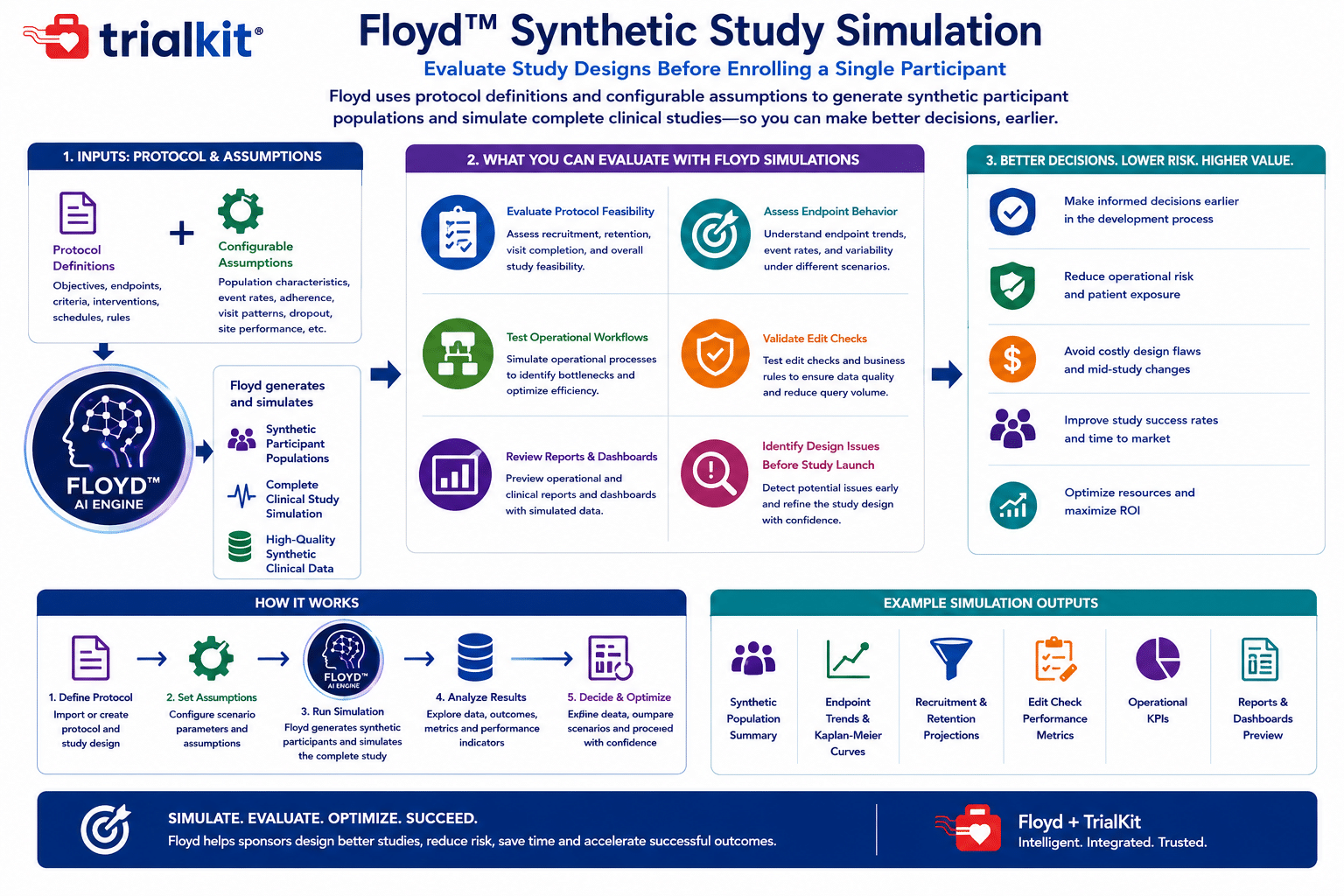
AI study simulation brings that visibility forward, allowing teams to explore how a trial is likely to perform before patients are enrolled. Simulations use the structure of the protocol itself to inform planning and decision-making and often employ virtual patient models to reflect how real patients are likely to progress through the study.
Protocol Design Feels Different When You Can See It Play Out
Protocol discussions often rely on experience and instinct. That is not a flaw, it is how the industry has operated for years. But it also means that many design decisions are based on what worked before, not necessarily what will work here.
When teams can model how a study unfolds, the conversation changes. Instead of debating hypotheticals, they can look at how virtual patients move through visits, where variability begins to creep in, and which parts of the design may introduce friction.
A few areas tend to come into focus quickly:
- Visit schedules that look reasonable on paper but create burden in practice
- Data collection points that may lead to inconsistency or missing data
- Endpoints that may be harder to interpret once variability is introduced
None of this guarantees a perfect protocol, but it reduces the number of unknowns heading into execution.
Eligibility Criteria Become Easier to Calibrate
Eligibility criteria tend to be one of the more debated parts of a protocol, and for good reason. The balance between scientific rigor and enrollment feasibility is never simple.
Broadening criteria can open up access to more patients, but it may introduce more variability into the data. Tightening criteria can support cleaner analysis, but at the risk of slowing enrollment or limiting generalizability.
Being able to see how those decisions affect the shape of the study helps cut through some of that back-and-forth. Changes in criteria can be explored in terms of how they influence the size of the eligible population, how quickly patients are likely to enroll, and how consistent the data may be over time.
That kind of visibility does not remove the tradeoffs, but it makes them easier to understand and easier to explain across teams.
Operational Risk Stops Being Abstract
Most teams have a sense of where operational challenges might arise, but risks are often discussed in broad terms. Site variability, patient engagement, and regional differences are all familiar themes, yet they are difficult to quantify before a study begins.
Working through different scenarios helps bring those risks into sharper focus. These scenarios are built by modeling how virtual participants behave under different conditions, such as varying enrollment rates or dropout patterns and reveal trends, such as:
- Certain regions or site types they consistently introduce delays
- Stages of the study where dropouts have the greatest impact
- Types of small, early disruptions with the most profound downstream effects on timelines
Some studies show resilience under changing conditions, while others reveal clear pressure points. That distinction can influence everything from site selection to monitoring strategy.
Endpoints Tell a Story Earlier
Endpoint behavior often remains uncertain until data starts coming in. Variability, timing, and patient response all play a role in how results ultimately take shape.
Looking at how endpoints may evolve over time adds useful context. It becomes possible to see where variability may affect interpretation, how sensitive results are to certain assumptions, and whether the study is positioned to capture meaningful change.
This kind of exploration often leads to more alignment between clinical, data, and statistical teams. Expectations become clearer, and the path to analysis feels less uncertain.
Timelines Become More Grounded
Timeline planning has always involved a degree of estimation. Historical benchmarks provide a reference point, but they do not always reflect the nuances of a specific study.
Exploring different scenarios brings more realism into those discussions. Adjusting enrollment rates or dropout patterns can quickly show how sensitive a study is to change. Some timelines hold steady across a range of conditions, while others shift more dramatically.
That visibility tends to sharpen planning:
- Timelines become easier to explain to stakeholders
- Risks can be communicated earlier and more clearly
- Contingency planning becomes more targeted
It becomes easier to set expectations that reflect how the study is likely to behave, not just how it is hoped to perform.
Bringing It Closer to the Team
For a long time, study simulation was something that required specialized tools or support, which limited how often it was used and who could access it.
That dynamic is starting to change. When simulation is available within the same environment used to design and manage studies, it becomes part of the natural flow of work. Questions can be explored as they come up, without waiting for separate analyses or moving data between systems.
The impact is subtle but important. Insights stay closer to the people making decisions, and those decisions can be made with more context.
A More Informed Starting Point
Clinical trials will always involve uncertainty. No amount of modeling replaces what happens in the real world once patients are enrolled and data begins to accumulate. What changes is the starting point. Teams move into execution with a clearer sense of how their study may behave and where attention is likely needed.
As these capabilities continue to evolve, the most useful implementations will be the ones that fit naturally into how teams already work. When that happens, study simulation becomes less of a specialized activity and more of a practical tool for shaping better trials.
Platforms such as TrialKit are moving in that direction by embedding these capabilities directly into the study environment, allowing teams to explore scenarios without stepping outside their core workflows.
Learn more about study simulation through TrialKit AI today.