

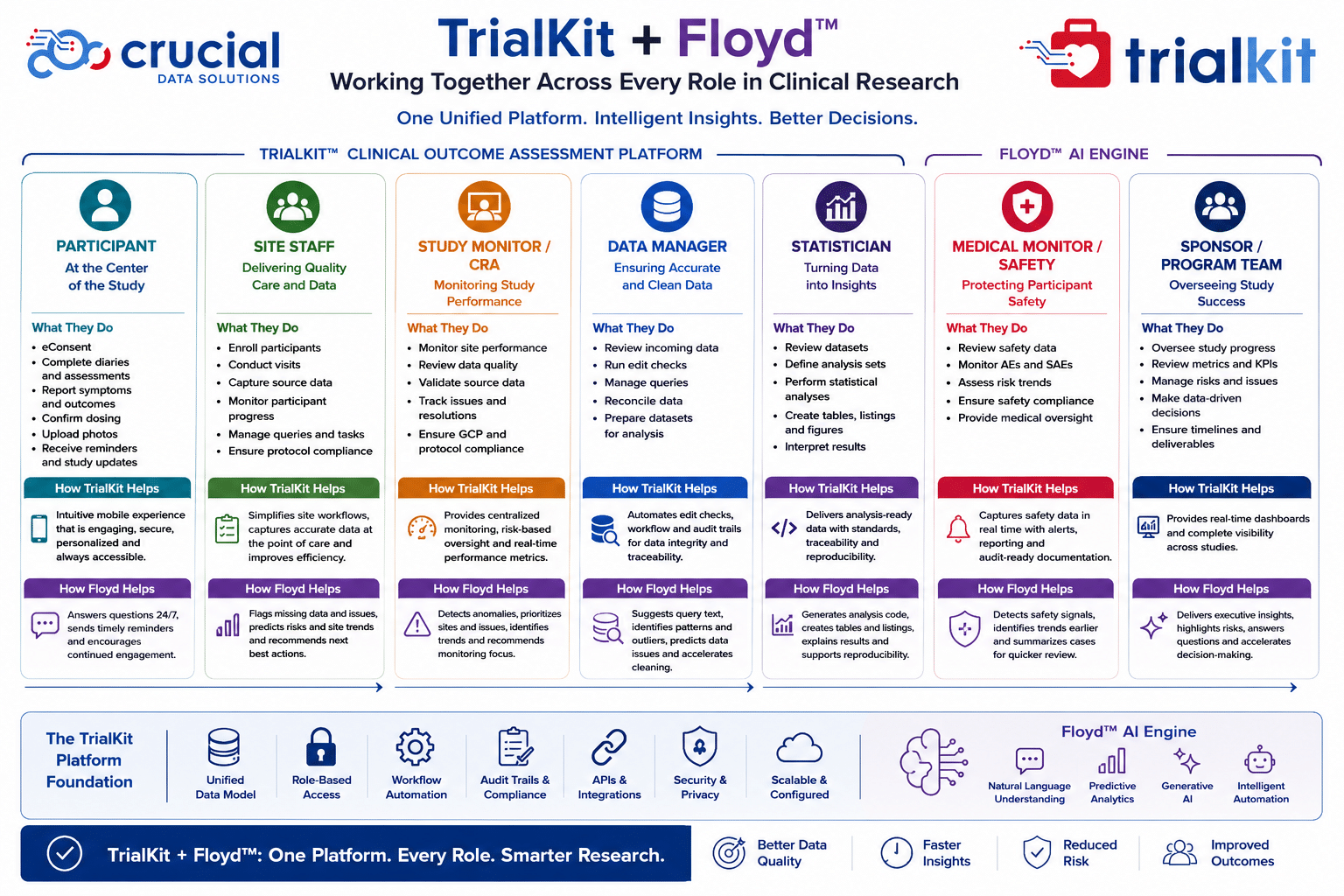
Clinical data managers spend much of the study turning a growing volume of information into something teams can review, trust, and use. That work includes tracking data completeness, resolving queries, monitoring site activity, preparing reports, reconciling sources, and keeping stakeholders informed as the study moves toward closeout.
TrialKit brings data capture, query management, reporting, analytics, and related eClinical functions into one platform. TrialKit AI, powered by TrialKit’s model Floyd, gives authorized users a natural-language way to investigate the data held there. For data management teams, the value comes from applying those capabilities to specific questions and recurring tasks.
Use Case #1: Answering Study Questions Without Building a New Report
Data reviews often produce questions that fall outside a standard report. A data manager may need to compare enrollment across regions, identify participants approaching an upcoming visit, or determine how many records meet a specific set of study criteria. Answering each new question through a custom report can slow the review process.
TrialKit AI allows authorized users to query live TrialKit data using natural language. Because Floyd understands how the data is organized within the study, users can move from a broad question to a more focused line of inquiry without first translating every request into reporting specifications. Practical questions may include:
- How does enrollment compare across regions?
- Which participants have visits due in the next 30 days?
- How many participants have completed a specific assessment?
- Which records meet a defined set of study criteria?
The results give data managers a starting point for review. They still confirm the underlying records, apply study context, and decide what follow-up is appropriate. The gain is faster access to the information needed to begin that work.
Use Case #2: Investigating Data Quality Trends and Potential Anomalies
Data quality review involves looking beyond individual records to understand whether an issue is isolated or part of a larger pattern. Unexpected values, repeated missing fields, unusual site-level activity, and changes in data-entry behavior may all warrant a closer look.
TrialKit AI gives data managers a faster way to investigate these signals across live study data. A user can ask Floyd where a pattern appears, whether it is concentrated at certain sites or visits, and which records warrant closer examination. The results remain linked to the underlying TrialKit records, allowing data managers to move directly from a signal to a detailed review.
These findings help data managers narrow the scope of their review and determine the appropriate next step. The team can examine the relevant records, confirm whether the pattern represents a data-quality issue, and decide whether follow-up is needed with a site, monitor, or other study stakeholder.
Use Case #3: Prioritizing Query and Site Follow-Up
Query volume alone does not tell data managers where follow-up will have the greatest effect. Teams also need to consider how long queries have remained open, which locations account for the greatest share of the backlog, and whether recurring questions point to a broader training or workflow issue.
Floyd lets users ask questions of current study data to identify patterns in query activity and site performance. A data manager could ask which sites have both a high volume of open queries and increasing response times, where the same type of query appears repeatedly, or which records have remained unresolved beyond an expected timeframe. The results can then be reviewed alongside the associated records, query histories, audit trails, and site activity held within TrialKit.
With that information, data managers can direct attention to the sites and records that require closer review, coordinate follow-up with monitors and site teams, and use current study data to see whether the issue improves.
Use Case #4: Testing Study Configuration Before Live Data Collection
Data management work begins well before the first participant enters a study. Forms, edit checks, conditional logic, and business rules all need to work together as intended. Testing those elements early helps teams confirm that the study will collect the right data and respond appropriately to different participant and site scenarios.
TrialKit AI can support this process by generating synthetic participants and using them to test the configured study. These simulated records can follow different paths through visits, forms, and data-entry scenarios, allowing teams to evaluate edit checks, branching logic, required fields, and other study rules across a range of simulated conditions.
This gives data managers and study builders a broader way to exercise the configuration and identify areas that need review. Teams can examine the results, make adjustments, and repeat the process as the study evolves. AI-assisted validation adds useful testing capacity while keeping approval and configuration decisions with the study team.
Use Case #5: Reviewing Data Across the Connected Study
Clinical study data can come from electronic data capture, electronic clinical outcome assessments, direct data capture, randomization and trial supply management, imaging, medical coding, and other study activities. TrialKit brings these functions together through a shared platform and data model, giving TrialKit AI a connected body of study information to work with.
That context expands the questions data managers can explore with Floyd. A user can examine a potential issue across participant records, visits, query activity, coding status, imaging data, or other connected sources without first assembling information from multiple standalone systems. The underlying records, audit history, and role-based access controls remain part of the same environment.
For data managers, this creates a more complete view of what is happening across the study. Information from one study activity can be examined in the context of related participant, visit, coding, imaging, and operational data. The shared architecture gives TrialKit AI the context needed to support broader questions while allowing the study team to verify findings at the source.
The End Result: Smoother Closeout with Fewer Last-Minute Questions
Closeout depends on steady progress long before the final data review. By helping teams answer study questions, examine data-quality signals, prioritize follow-up, validate study configuration, and review connected data throughout execution, TrialKit AI can help data managers address outstanding work while sites are still actively engaged.
As the study approaches closeout, teams can use Floyd to explore remaining trends or data-quality questions, then verify the relevant records and complete the controlled review required for a clean, reliable dataset.
See how TrialKit can support practical data management from ongoing review through study closeout. Contact Crucial Data Solutions today to request a demo.