
Collecting a clinical outcome electronically may seem like a relatively simple change from collecting the same information on paper. The implications for the resulting data, however, can be significant.
Clinical outcome assessments often depend on information collected directly from participants, clinicians, or caregivers at specific points during a study. How that information is captured can affect its completeness, timeliness, traceability, and ultimately its usefulness to the research team.
Electronic clinical outcome assessment (eCOA) and electronic patient-reported outcome (ePRO) technologies give research teams greater control over that collection process. They can help reduce manual transcription, encourage assessments to be completed when intended, identify missing information earlier, and make outcome data available while a study is still underway.
Therefore, the value of eCOA and ePRO extends beyond replacing paper with a screen. Their greater value lies in the quality and usability of the data they help produce.
Why Data Collection Method Affects Clinical Trial Data Quality
Clinical outcome data is only as useful as the process used to collect it.
Paper-based assessments introduce several opportunities for problems. An assessment may be completed late, a participant may leave a question unanswered, handwriting may be difficult to interpret, or responses may need to be manually entered into another system before they can be analyzed.
Each additional step creates another opportunity for missing information, transcription errors, or delays.
Electronic collection can remove many of those steps. Participants, clinicians, and observers enter information directly into the system, where it can be checked against predefined requirements and made available to authorized study personnel.
That doesn’t automatically make electronically collected data high quality. The assessment itself still needs to be appropriate for the study, and the technology and collection process need to be designed around the intended use of the data. FDA’s Clinical Outcome Assessment Compendium provides a useful starting point for understanding how different COAs have been used to measure patient experience in clinical trials.
For research teams, the technology should reinforce a well-designed assessment strategy rather than compensate for a poorly designed one.
How eCOA and ePRO Support Timely Data Collection
Timing can have a direct effect on the usefulness of outcome data.
This is particularly important for patient-reported outcomes. Asking someone to describe symptoms or functioning from several days ago may produce a different response than collecting that information closer to when the experience occurred.
Electronic assessments can be scheduled around the protocol and made available during defined completion windows. Notifications can remind participants when an assessment is due, while timestamps provide study teams with information about when a response was actually submitted.
That gives researchers more context around the data they receive and reduces reliance on assessments completed retrospectively.
For ePRO in particular, this can help preserve one of the primary reasons for collecting patient-reported data in the first place: understanding the participant’s experience directly and at the appropriate point in the study.
Reducing Transcription and Data Entry Errors
Paper collection often requires information to move through several hands before it reaches the study database.
A participant may complete an assessment on paper. Site personnel may review it. Someone may then enter the responses into an electronic system. Data management may subsequently identify an inconsistency and send a query back to the site.
Direct electronic capture removes some of those handoffs.
When responses are entered electronically at the source, there is less need to transcribe information from one format into another. Built-in validation can also identify certain missing, incomplete, or improperly formatted responses while the assessment is being completed rather than waiting until downstream review.
This doesn’t eliminate the need for data review. It reduces avoidable work created by the collection process itself.
How eCOA Can Improve Data Completeness and Assessment Compliance
Missing outcome data can be particularly difficult to address after the fact. If a participant was supposed to complete an assessment at a particular point in the study and didn’t, recreating that response later may not provide equivalent information.
eCOA and ePRO systems can help study teams manage this problem earlier.
Scheduled notifications can remind participants or other users that an assessment is due. Required fields and completion rules can reduce unintentionally skipped questions. Study teams can also monitor completion status while assessments are underway rather than discovering gaps during later data cleaning.
This visibility allows sites and study teams to identify patterns that may require attention. If assessments are repeatedly being missed, for example, the issue may be related to participant burden, study instructions, technology access, or the design of the workflow itself.
The data can therefore tell researchers something about study execution as well as the outcome being measured.
Adding Context Through Timestamps and Audit Trails
A response alone doesn’t always tell the full story.
Electronic systems can provide metadata that helps researchers understand when an assessment was completed and how the record changed over time. Timestamps, audit trails, and controlled user access create a clearer history around the information being collected.
This is particularly valuable when questions arise later in the study.
Rather than trying to determine when a paper diary was completed or reconstruct how a value changed, study teams can review the electronic record associated with that data.
Traceability doesn’t make the outcome itself more meaningful, but it can give researchers greater confidence in how that outcome was collected and managed.
Real-Time Access to eCOA and ePRO Data
One of the most practical differences between electronic and paper-based collection is how quickly the information becomes usable.
When eCOA and ePRO data are captured electronically, authorized study personnel can review incoming information without waiting for paper forms to be returned, entered, and reconciled.
That can change how teams oversee a study.
Researchers can monitor assessment completion, identify emerging data-quality issues, and review outcome trends while data collection is still taking place. Depending on the study design and system configuration, responses may also trigger notifications or workflows that require follow-up.
This is especially relevant as more clinical research takes place outside traditional site visits. FDA’s guidance on digital health technologies for remote data acquisition addresses the use of technologies that collect data remotely from trial participants and emphasizes considerations such as whether a technology is fit for purpose, its validation, and the integrity and security of the resulting data.
Remote collection expands where and how outcome data can be gathered, but it also makes thoughtful technology selection and study design increasingly important.
Bringing eCOA and ePRO Data Together With Other Study Data
Outcome data becomes more useful when researchers can evaluate it alongside the rest of the study.
This can be difficult when eCOA operates as a separate system from EDC, wearable data, laboratory information, or other study technologies. Even when each system works well independently, data may need to be transferred, reconciled, or combined before researchers can see the larger picture.
A unified environment reduces some of that fragmentation.
Participant-reported outcomes, clinical assessments, wearable measurements, and other study data can be viewed within a broader study context rather than treated as isolated datasets. That can simplify oversight and give researchers more opportunities to examine relationships between different types of information.
For studies collecting a growing variety of digital data, the ability to bring those sources together is becoming increasingly important.
AI Creates New Ways to Work With eCOA Data
As outcome datasets become larger and more varied, study teams also need better ways to work with the information they’ve collected.
AI-assisted analysis can help researchers explore data, identify patterns, and ask questions across study datasets. With eCOA and ePRO, this creates opportunities to examine participant-reported information alongside other clinical and operational data as a study progresses.
The quality of the underlying data remains critical. AI doesn’t resolve missing assessments, poorly selected instruments, inconsistent collection methods, or disconnected datasets. Its usefulness depends in part on having structured, accessible information to work with.
This makes the decisions made during data collection increasingly relevant to what researchers can do with that data later.
How TrialKit Supports High-Quality eCOA and ePRO Data Collection
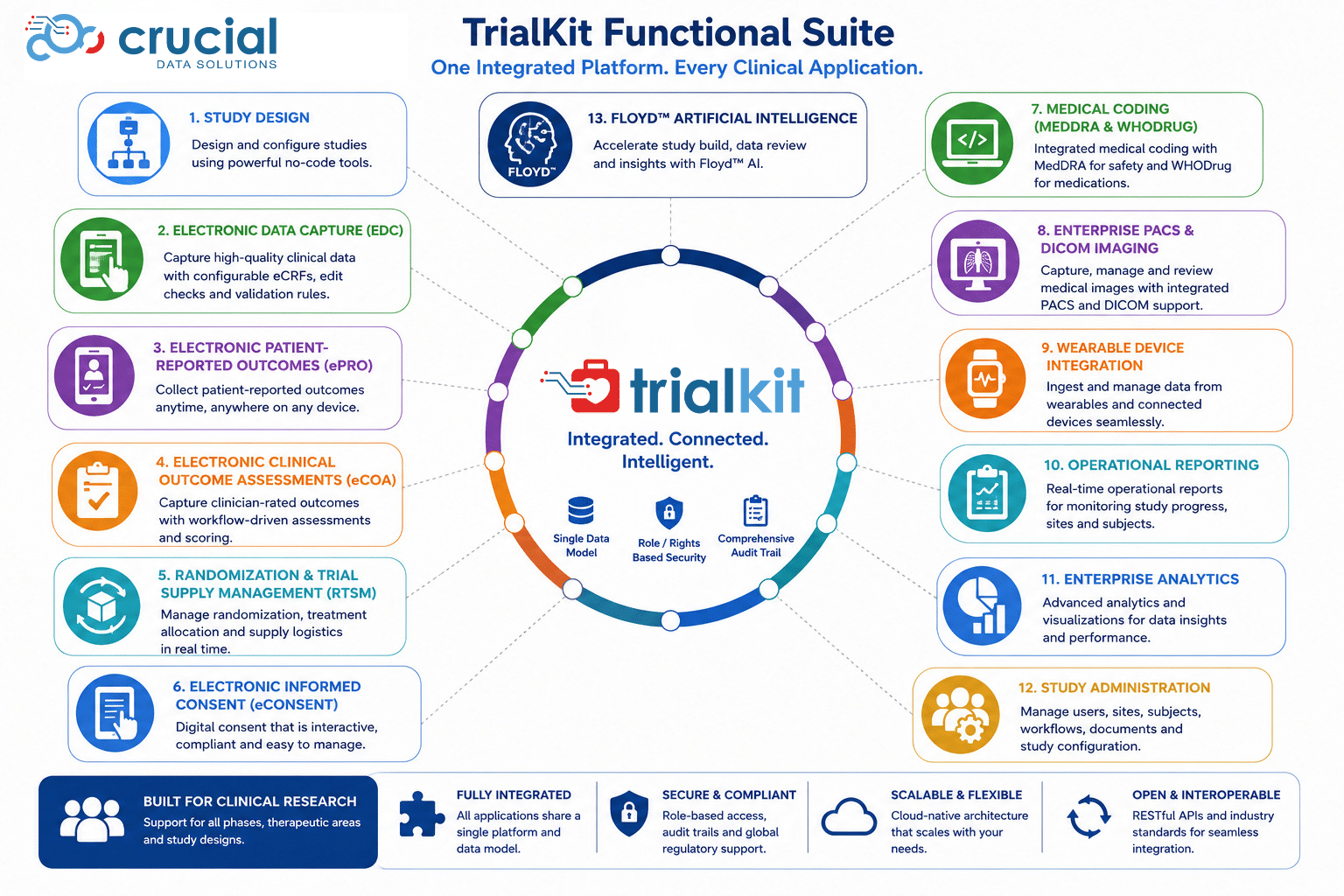
TrialKit brings eCOA and ePRO together with EDC and other clinical trial capabilities within a unified platform.
Participants can complete assessments through mobile-friendly interfaces using study-provisioned devices or their own devices through a bring-your-own-device (BYOD) approach. Research teams can configure assessments around protocol requirements, establish notifications and workflows, monitor incoming information, and work with outcome data alongside other study data.
Because eCOA isn’t isolated from the rest of the TrialKit environment, researchers can work with participant-reported and other outcome data within the broader context of the study.
TrialKit’s AI model, Floyd, adds another layer to that environment. Researchers can use TrialKit AI to query study data, explore trends and signals, and support analysis and reporting. These capabilities operate within the same platform where study data is collected and managed, reducing the need to move information into a separate AI environment before working with it.
For organizations evaluating eCOA technology, that broader data environment deserves consideration alongside the participant-facing experience. Collecting an assessment is the beginning of the process. The information also needs to be reviewed, managed, understood, and eventually incorporated into the larger study dataset.
Designing eCOA Around the Data You Need
The decision to use eCOA or ePRO should begin with the outcome a study needs to measure.
Researchers need to consider who will complete the assessment, when it should be completed, which instrument is appropriate, how participants will access the technology, and what will happen to the data after it’s submitted.
Those decisions influence both the participant experience and the quality of the resulting dataset.
Technology can make the collection process more efficient and controlled, but its value ultimately depends on how well it supports the study’s objectives. A thoughtfully designed eCOA strategy gives researchers something more useful than a digital replacement for paper. It creates a clearer path from the person completing an assessment to the people responsible for understanding the resulting data.
Learn More About TrialKit
TrialKit provides eCOA and ePRO capabilities within a unified eClinical platform, giving research teams a way to collect participant and clinical outcome data alongside the other information generated throughout a study.
Learn more about TrialKit’s eCOA and ePRO capabilities or contact our team to see how the platform can support your study.
Frequently Asked Questions About eCOA and Data Quality
How does eCOA improve clinical trial data quality?
eCOA can improve data quality by reducing manual transcription, applying completion and validation rules during data collection, recording timestamps, and giving study teams earlier visibility into missing or inconsistent information. The quality of the resulting data still depends on appropriate assessment selection, study design, and implementation.
How can ePRO reduce recall bias?
ePRO assessments can be scheduled closer to the experience they’re intended to measure rather than asking participants to reconstruct symptoms or experiences much later. Electronic timestamps also allow study teams to determine when an assessment was submitted relative to its intended collection window.
Can eCOA reduce missing data in clinical trials?
eCOA can help reduce some sources of missing data through scheduled reminders, required fields, completion rules, and real-time monitoring of assessment status. It can’t eliminate missing data entirely, since participant burden, technology access, study design, and other factors can still affect completion.
Why is real-time access to eCOA data useful?
Earlier access allows study teams to monitor completion, identify potential data-quality problems, and review outcome information while a study is underway. This can reduce the amount of time between a problem occurring and the research team becoming aware of it.