

Electronic data capture (EDC) has traditionally occupied a clearly defined place in the clinical trial lifecycle. Once a protocol is designed and a study database is built, the EDC becomes the environment where clinical data is collected, reviewed, queried, and prepared for analysis.
Artificial intelligence is beginning to expand that role.
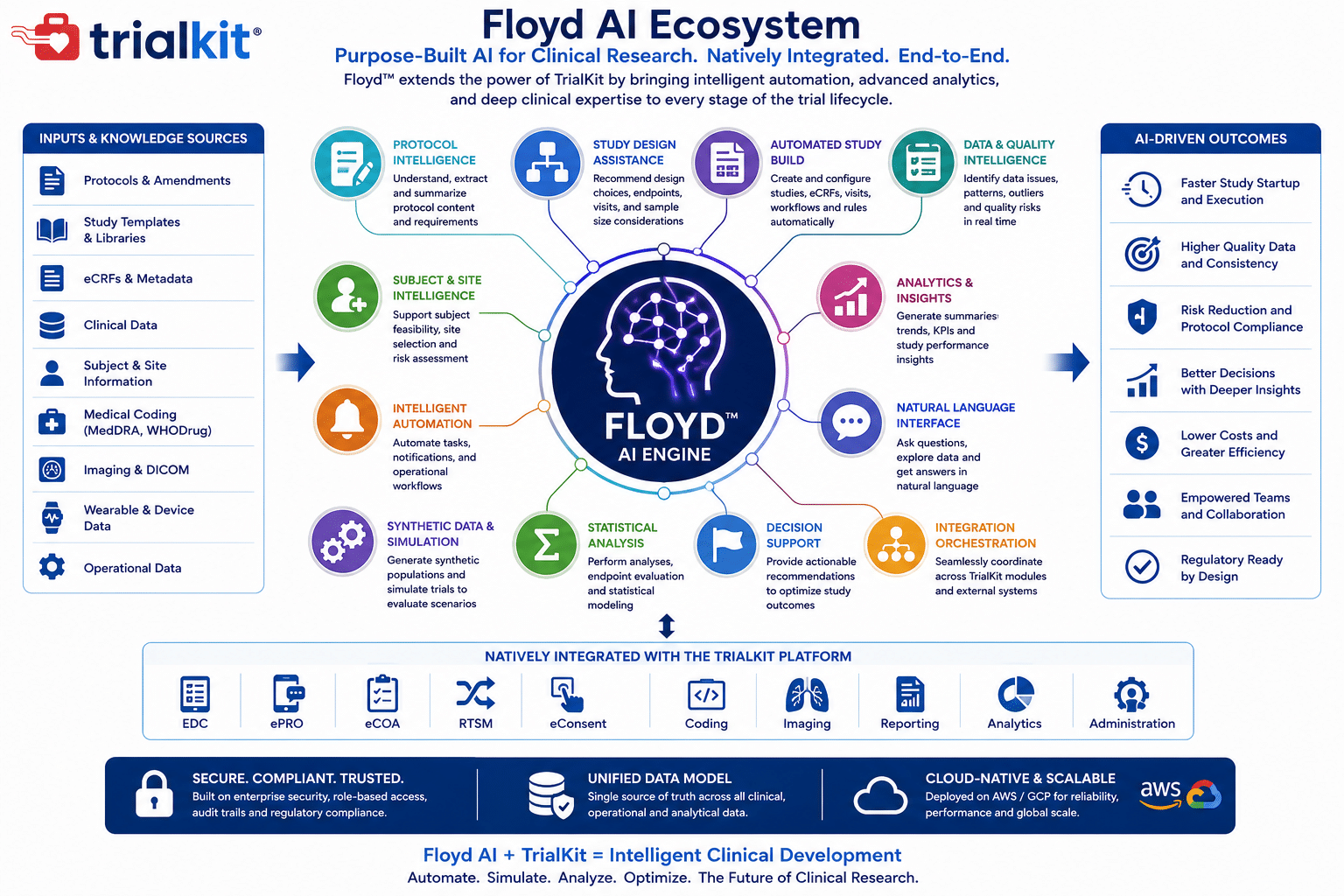
Rather than applying AI only after clinical data has accumulated, emerging capabilities can support work on both sides of data capture. AI can help translate protocol requirements into a working study, test that configuration before enrollment, analyze study data as it accumulates, and compare actual study behavior with earlier expectations.
TrialKit reflects this broader model. Its EDC sits within a unified eClinical platform that connects study design, data collection, participant-facing workflows, validation, reporting, and analysis. TrialKit AI, powered by TrialKit’s AI model, Floyd, extends intelligence across that environment.
The result is an EDC system that can play a more active role throughout the study lifecycle.
Using AI to Accelerate EDC Study Building
One of the most labor-intensive parts of EDC implementation happens before data collection begins.
Protocol requirements have to be translated into eCRFs, fields, visits, schedules, edit checks, calculations, participant diaries, conditional logic, and other study components. Traditionally, much of that translation requires teams to interpret the protocol and manually reproduce its requirements within the EDC.
Floyd changes where AI can enter this process. Because Floyd understands TrialKit’s APIs, backend data model, study architecture, and the relationships between protocols, forms, visits, workflows, and study data, it can use protocol content and study requirements to generate foundational components of a TrialKit study.
These can include:
- eCRFs and field libraries
- Visit schedules
- Workflows
- Edit checks
- Calculations
- Participant diaries
- Study logic
Instead of beginning with an empty study and configuring each component individually, teams can begin with an AI-generated foundation and review and refine it within TrialKit.
Human oversight remains part of the process. Study professionals determine whether the resulting configuration accurately reflects the protocol and meets the operational and data requirements of the study. AI changes how much of the initial translation and configuration has to be performed manually.
Using AI for EDC Study Validation Before Enrollment
Building a study is only one part of database preparation. Teams also need confidence that the resulting configuration behaves as intended. This creates another opportunity for AI within the EDC.
Floyd can generate synthetic participants and study data within TrialKit to exercise the configured study before enrollment begins. Those synthetic records can be used to test elements such as edit checks, calculations, required fields, visit schedules, workflows, and protocol logic.
This gives study teams an opportunity to observe how the database behaves under different scenarios before real participant data enters the system.
If a workflow produces an unexpected result, an edit check does not behave as intended, or the configuration does not accurately represent a protocol requirement, teams have an opportunity to investigate and refine the study while it is still in validation.
The EDC therefore becomes more than the eventual destination for clinical data. It also becomes an environment for testing the structure through which that data will eventually move.
Connecting Study Design with Study Execution
Once enrollment begins, the focus shifts from anticipated study behavior to actual study behavior. This is where connecting study design, configuration, and live data within the same environment becomes particularly useful.
TrialKit brings EDC together with other clinical workflows and data sources, including eCOA/ePRO, direct data capture, eConsent, RTSM, medical coding, imaging, wearables, and other study functions. Rather than treating these activities as isolated systems, the platform maintains relationships among participants, visits, forms, workflows, and the data they produce.
Floyd operates within that same environment. The context used to help build and validate the study can therefore remain relevant as the study progresses. Teams can move from asking whether a study should behave a certain way during validation to examining how it is behaving once participants and sites begin generating data.
That creates continuity between study design and study oversight that is difficult to achieve when design, configuration, data capture, and analysis are handled through disconnected systems.
Asking Questions of Live Clinical Data
As clinical data accumulates, study teams routinely encounter questions that were not anticipated when standard reports and dashboards were created.
A data manager may want to know whether missing data is concentrated at particular visits. A clinical operations team may need to investigate changes in activity at a specific site. A study leader may want to examine an unexpected participant trend or determine whether protocol compliance differs across sites.
Answering these questions has traditionally required some combination of predefined reports, custom queries, data exports, or specialized analytical support. TrialKit AI provides another path.
Authorized users can query live TrialKit data using natural language to investigate areas including:
- Data quality
- Participant activity
- Site performance
- Protocol compliance
- Operational metrics
- Emerging trends within study data
Because Floyd understands the structure of the TrialKit study, those questions can be evaluated within the context of the forms, visits, participants, sites, and workflows represented in the database.
These capabilities complement established clinical trial data management processes rather than removing the need for clinical, statistical, or data-management judgment. The people responsible for the study still determine whether a finding is meaningful and what action, if any, it warrants. AI can shorten the distance between recognizing a question and reaching the data needed to investigate it.
Comparing Expected and Actual Study Behavior
Perhaps the more significant change comes from connecting what happened before enrollment with what happens afterward.
Synthetic participants allow teams to evaluate expected study behavior before live data collection. Once a study is underway, Floyd can also analyze real participant data within TrialKit.
Those two capabilities create the potential to compare expectations established during study preparation with actual study performance.
Teams can investigate whether real participant activity differs from the scenarios explored before launch, whether operational patterns are developing differently than expected, or whether emerging data warrants closer examination.
This creates a feedback loop across the study lifecycle:
Design the study → build it → test it with synthetic data → collect live data → compare and investigate
Instead of treating study build, validation, execution, and analysis as separate technology stages, intelligence can follow the study from its initial configuration through ongoing review.
The EDC as Part of a Connected Clinical Intelligence Environment
The evolution of EDC is therefore broader than adding AI-powered analytics to an existing database.
Data capture remains fundamental. Study teams still need reliable eCRFs, validation rules, query management, audit trails, role-based access, mobile data collection, and the other capabilities expected of a modern EDC.
What is changing is what can happen around that data.
With TrialKit AI, intelligence can be applied before the first participant is enrolled to help configure and test the study. During execution, the same environment can collect clinical data and support ongoing operational workflows. As information accumulates, teams can use natural-language analysis to investigate study performance and compare actual behavior with earlier expectations.
That progression moves the EDC closer to a continuous clinical intelligence environment, where the structure of the study and the data generated by it remain connected throughout the lifecycle.
From Data Capture to Study Intelligence
The next stage of EDC development may be defined less by how much data a platform can collect and more by what research teams can do with the context surrounding that data.
TrialKit combines EDC with study design, validation, synthetic data generation, reporting, analysis, and other connected clinical workflows. TrialKit’s AI model, Floyd, extends those capabilities by helping teams translate protocol requirements into study configuration, test that configuration before enrollment, investigate live clinical data, and compare expected study behavior with real-world study activity.
The EDC still serves as a controlled system of record, with electronic systems used in clinical investigations subject to established expectations for reliable and trustworthy electronic records. It can now participate in a much larger process that begins with the protocol and continues through study execution and analysis.
Learn more about TrialKit EDC and TrialKit AI, or contact Crucial Data Solutions to see how Floyd works across the clinical trial lifecycle.