
The Next Research Volunteer
Nearly half of Americans have never considered a clinical trial, and practical barriers like distance may be keeping willing volunteers on the sidelines.
Many clinical trials hit an obstacle before ever recording a result: insufficient enrollment is one of the top reasons that clinical trials end up terminated. Even if researchers take all the right steps to prepare, a lack of willing participants can stop a trial before it starts. But what’s keeping people away from these trials?
To find out what stands between Americans and the research that depends on them, Crucial Data Solutions surveyed 1,000 U.S. adults about their experience with clinical studies: whether they’ve taken part, what would motivate them, what gets in the way, and what would have to change. The obstacles they named are strikingly ordinary. Distance to a research site. A strict work schedule. What they said would bring them in is equally concrete, and most of it is already technically possible. Their answers suggest that lowering those practical barriers could make participation feasible for a far broader pool of potential volunteers.
Key Takeaways
- 47% of Americans have never participated in or considered a clinical research study, and another 14% considered one but decided not to enroll, pointing to a massive pool of potential volunteers still on the sidelines.
- 88% name at least one part of their current routine that could make it hard to enroll in or complete a clinical research study, and 40% point to the distance to a research site, the single most commonly cited barrier, ahead of work schedule conflicts (38%) and limited transportation (18%). Distance is more than twice as common a barrier for Baby Boomers (52%) as it is for Gen Z (24%).
- 25% cite helping future patients as their main reason to consider a trial, followed closely by financial compensation at 21%, while only 6% cite a doctor’s recommendation.
- 83% would be more likely to join a study if they could complete most tasks from home, and 81% say the same about having travel or transportation costs covered, suggesting flexible, low-cost design could potentially address the biggest barriers to entry.
- 84% are comfortable using their own smartphone for study tasks, but 32% have never owned or used a smartwatch or fitness tracker. 28% say they’d only participate in wearable-based research if the study provided the device.
- 16% would not allow a study to access their genetic or DNA information under any circumstances, the highest refusal rate of any data type tested, compared to just 3% who would refuse to share basic health survey responses.
- Only 39% of past participants received a full summary of study results, and 15% received no outcome information at all, even though 76% say a results summary would make a big or some difference in helping them complete a study.
- Nearly 4 in 5 Americans say AI would be useful for tasks like estimating participant burden (79%) or catching operational problems before a study begins (77%), and 62% say knowing a trained professional reviews AI recommendations would increase their confidence in the study.
Half Haven’t Considered a Clinical Trial
People may assume that clinical trials are only for those with rare medical conditions. But researchers often need people of all health and fitness levels to test for efficacy, dosage standards, and more. Average Americans are eligible for many clinical trials – but most of them have no idea. Here’s how many people have seriously considered enrolling in a clinical trial, and how many never knew it was an option.
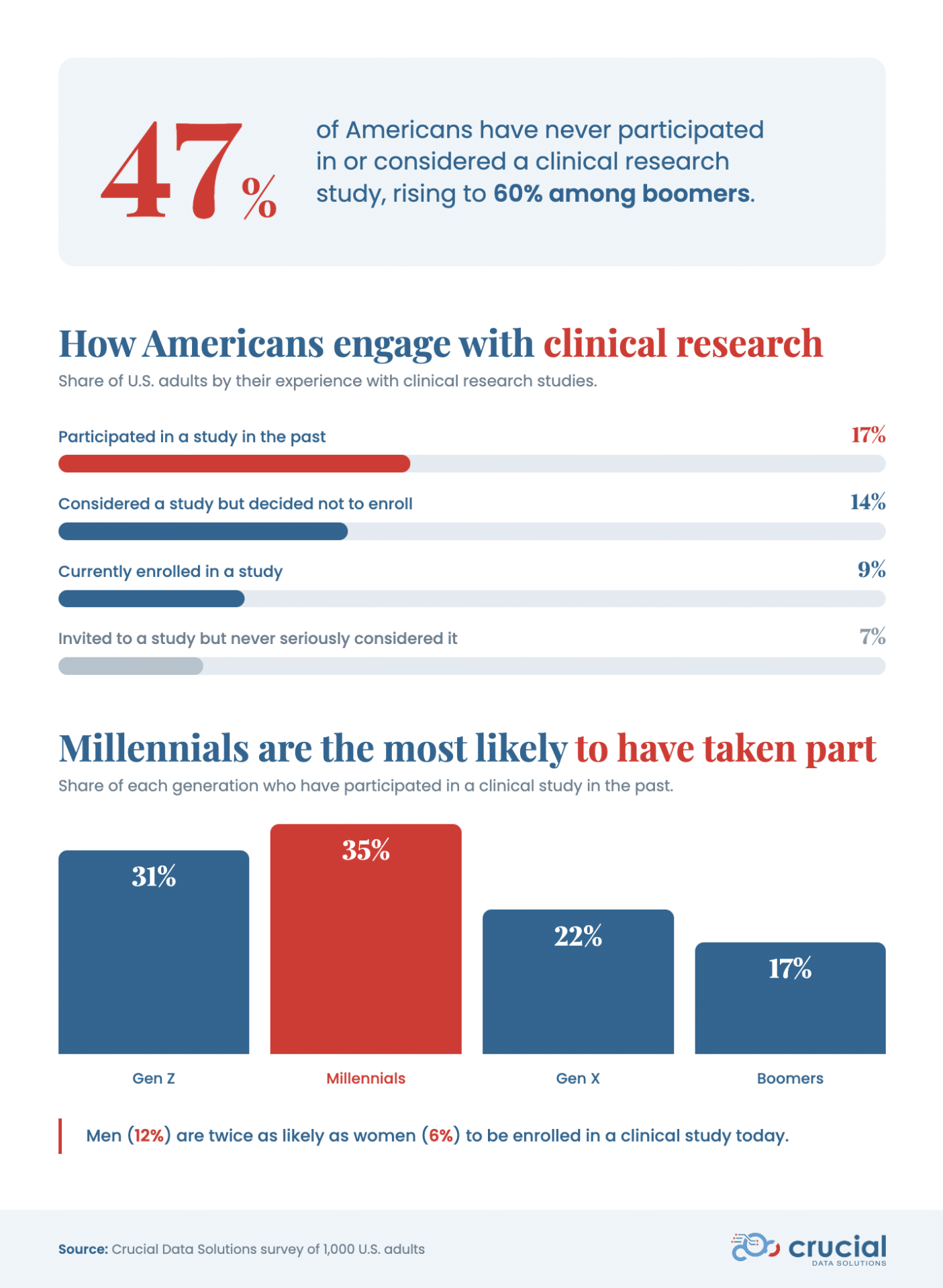
A small share (9%) of Americans are currently enrolled in a clinical trial, though nearly twice as many (17%) have participated in one in the past, including 8% who had done so in the last two years. But most Americans had never even considered it: 47% of Americans have never participated in a study or considered one. Another 14% thought it over and decided against enrolling, and 7% had been invited to participate but never seriously considered it.
A majority of Boomers (60%) have never participated in a study or considered one, compared to 44% of Gen Z, 39% of millennials, and 46% of Gen X. Millennials had the largest share of people who had participated in the past at 35%, followed closely by Gen Z at 31%. Gen X and boomers trailed behind at 22% and 17%, respectively. They were also the most likely to be currently enrolled in a study: 16% of millennials were participating in clinical studies, over five times the amount of boomers who said the same (3%).
Men reported more experience with clinical research than women on both counts. Nearly a third of men (30%) have taken part at some point, compared with just under a quarter of women (23%). The divide is wider on current enrollment, where men (12%) are twice as likely as women (6%) to be in a study today. This could be illustrative of the gender gap in medical research, where men are prioritized as subjects and are more likely to be selected for gender-neutral drug trials. It could also be an aftereffect of the fact that women of childbearing age were excluded from clinical trials for many years, both out of an interest to protect fetuses but also a misplaced belief that women’s hormones would make the data less reliable.
Why Volunteers Don’t Enroll
Even among those who have considered enrolling in a trial, certain factors make them hesitate. Those who work full-time need to know that the trial won’t interfere with their hours; those who care for children or other family members need to know side effects won’t incapacitate them. For most, the things that come between them and a clinical trial are practical concerns.
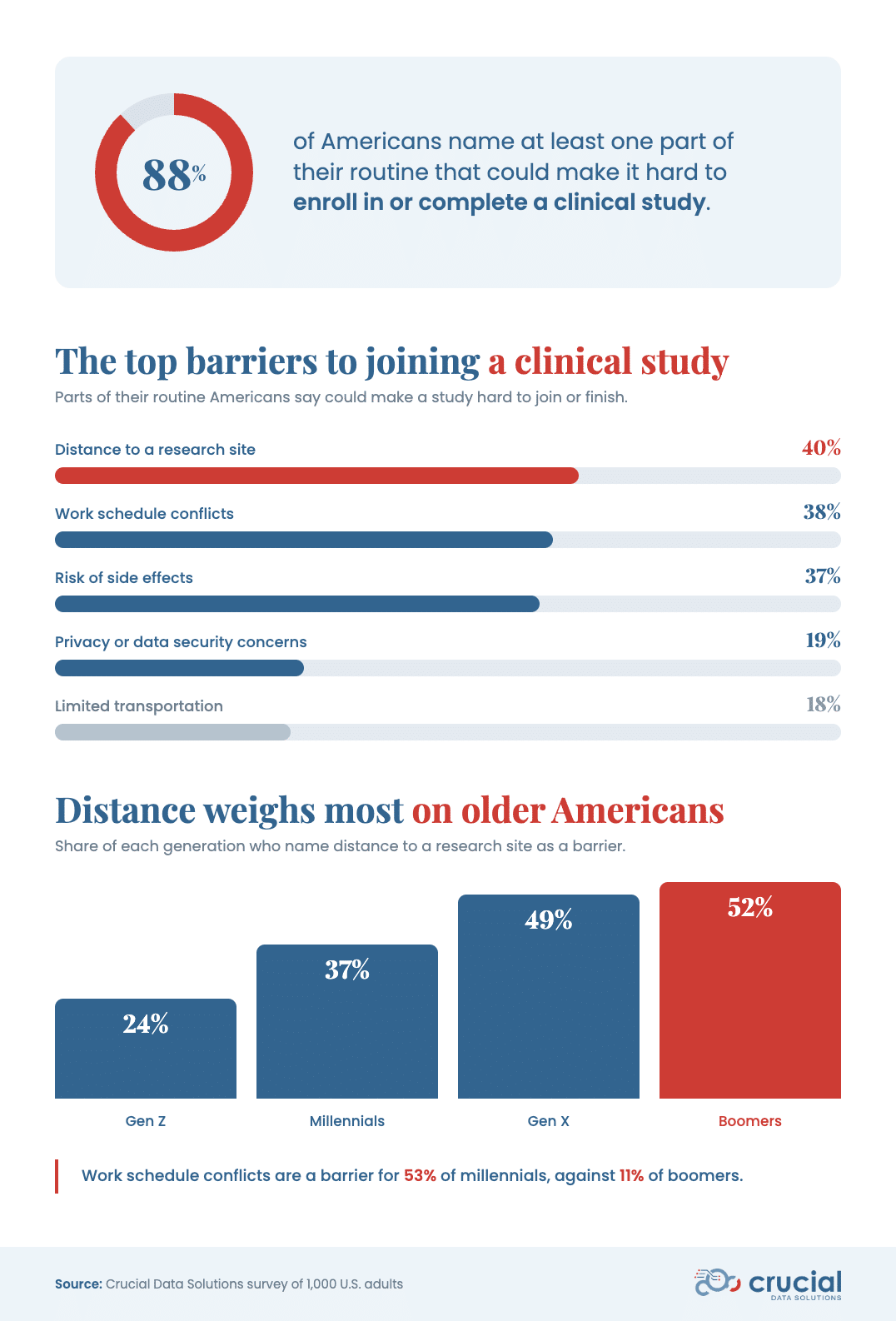
A large majority of Americans (88%) named at least one part of their current routine that made it hard to enroll in a study or finish one. Respondents pointed to distance from a research site most often (40%), with work schedule conflicts (38%) and the risk of side effects (37%) close behind. Privacy or data security concerns (19%) and limited transportation (18%) trailed by a wide margin.
Working-age Americans were far more likely to say their jobs got in the way. Millennials named work schedule conflicts most often (53%), with Gen X (46%) and Gen Z (40%) not far behind, while only 11% of boomers said the same. On childcare, 22% of millennials named it as a barrier, against 1% of boomers. Older respondents named distance more often, and the share climbed with each generation, from 24% of Gen Z to 37% of millennials, 49% of Gen X, and 52% of boomers.
Gen Z was the least likely to name privacy or data security as a barrier (15%), compared with 23% of Gen X and 22% of boomers. Younger respondents drew the same line later in the survey, when they weighed which kinds of health data they’d refuse to share outright.
Boomers stood apart in another way, with 19% saying none of the listed barriers applied to them, the highest share of any generation. Many boomers have left the workforce and are past the years of raising young children, which may leave them with fewer obligations to plan a study around.
Motivators for Participation
With that said, people do want to participate in clinical trials. While many trials provide financial compensation, most people don’t consider that their primary motivator. The most common reason people gave for signing up has nothing to do with money. It’s making sure others get care in the future.
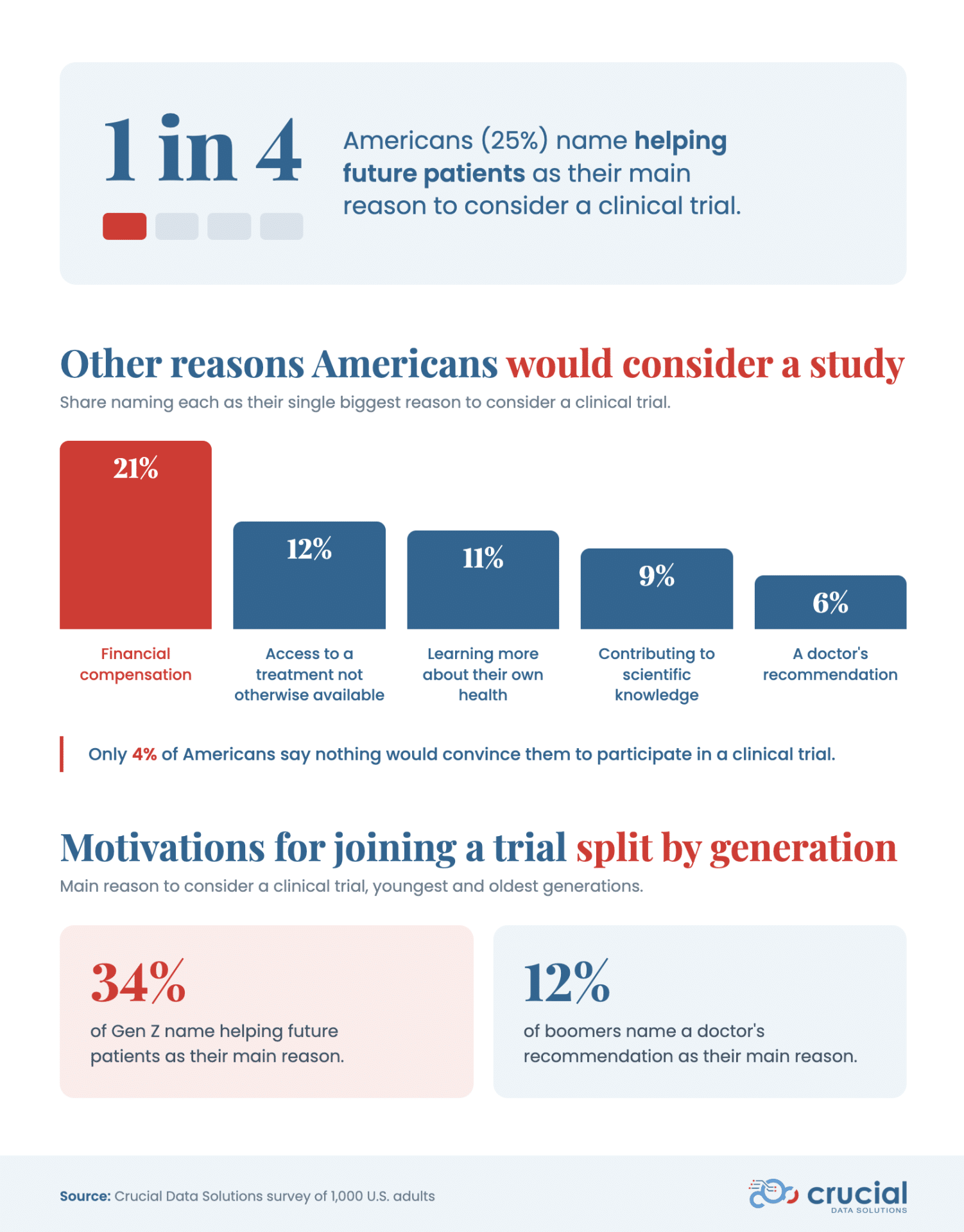
When asked for the single biggest reason they would consider a clinical trial, Americans named these:
- Helping future patients (25%);
- Financial compensation (21%);
- Access to a treatment not otherwise available (12%);
- Learning more about their own health (11%);
- Contributing to scientific knowledge (9%);
- A doctor’s recommendation (6%).
Only 4% said nothing would convince them to participate in a clinical trial.
Gen Z trended toward altruistic reasons to sign up for a clinical trial. Over a third (34%) of Zoomers said they were primarily motivated by the idea of helping future patients, far ahead of millennials (28%), Gen X (19%), and boomers (18%). Conversely, older generations are more motivated by money: 22% of Gen X and 17% of boomers named compensation as their number one motivation. Baby boomers put the most weight on professional advice, though. While 12% of boomers named a doctor recommendation as their primary motivator, only 3% of Gen Z said the same.
Everyone has a different reason to enroll. What matters to researchers is that they enroll at all.
Fixes That Could Improve Enrollment
If distance and scheduling are what’s keeping people out, researchers need fixes that will let them back in. Just as the obstacles are all practical considerations, the solutions are practical as well. Virtual visits and other flexible options can bring far more people into the trial.
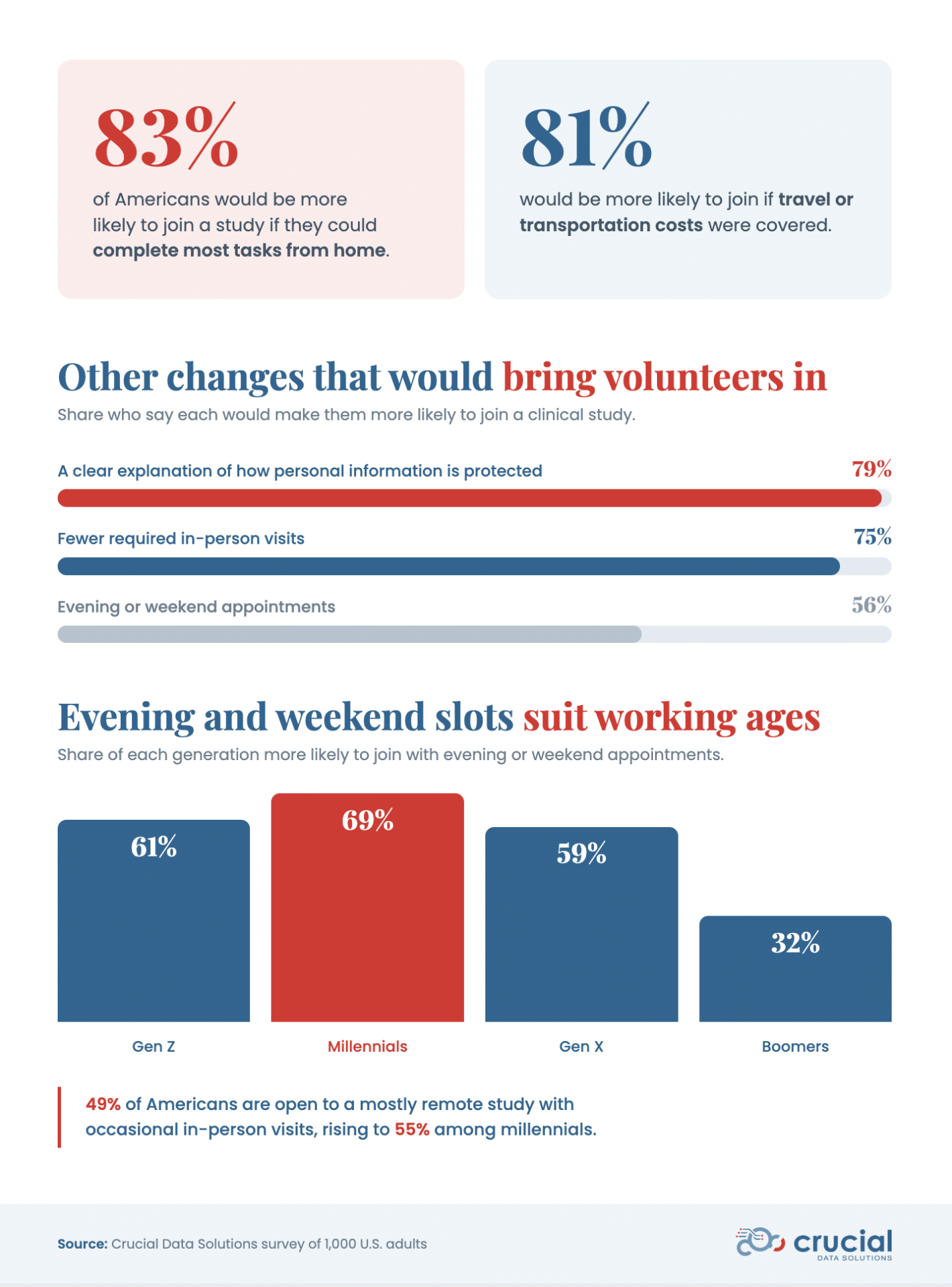
Being able to complete most study tasks remotely would make 83% more likely to join, and having travel or transportation costs covered would convince 81%. Cutting the number of required in-person visits drew 75%. Nearly four-fifths (79%) would enroll if they received a clear explanation of how their personal information would be protected. Evening or weekend appointment availability trailed the group at 56%, though that still amounts to a majority.
Younger respondents showed the most interest in scheduling flexibility. Millennials responded to evening or weekend availability most strongly (69%), followed by Gen Z (61%) and Gen X (59%). Boomers came in at 32%, roughly half the rate of every working-age generation. Many boomers have left the workforce, so fewer of them may need appointments that work around a job.
The overall format of the study mattered as well. Half (49%) of Americans were receptive to a mostly remote study with occasional in-person visits, rising to 55% among millennials. Boomers were least interested in fully remote studies (32%), and 11% of boomers said they wouldn’t participate in a six-month study under any format. Men and women diverged: 47% of women were open to a fully remote study against 41% of men, while men preferred the hybrid format (52% vs. 45%). One possible explanation is caregiving, which a fully remote format makes easier to work around, though the survey didn’t measure that link directly.
When distance and scheduling are some of the most common obstacles for Americans who would otherwise participate in these trials, remote and hybrid formats offer a viable alternative.
Not All Data Is Equal
In the age of data leaks, people are more discerning about who gets access to their medical information. While clinical trials often require some level of personal data, Americans are wary of handing over too much information without knowing where it will go.
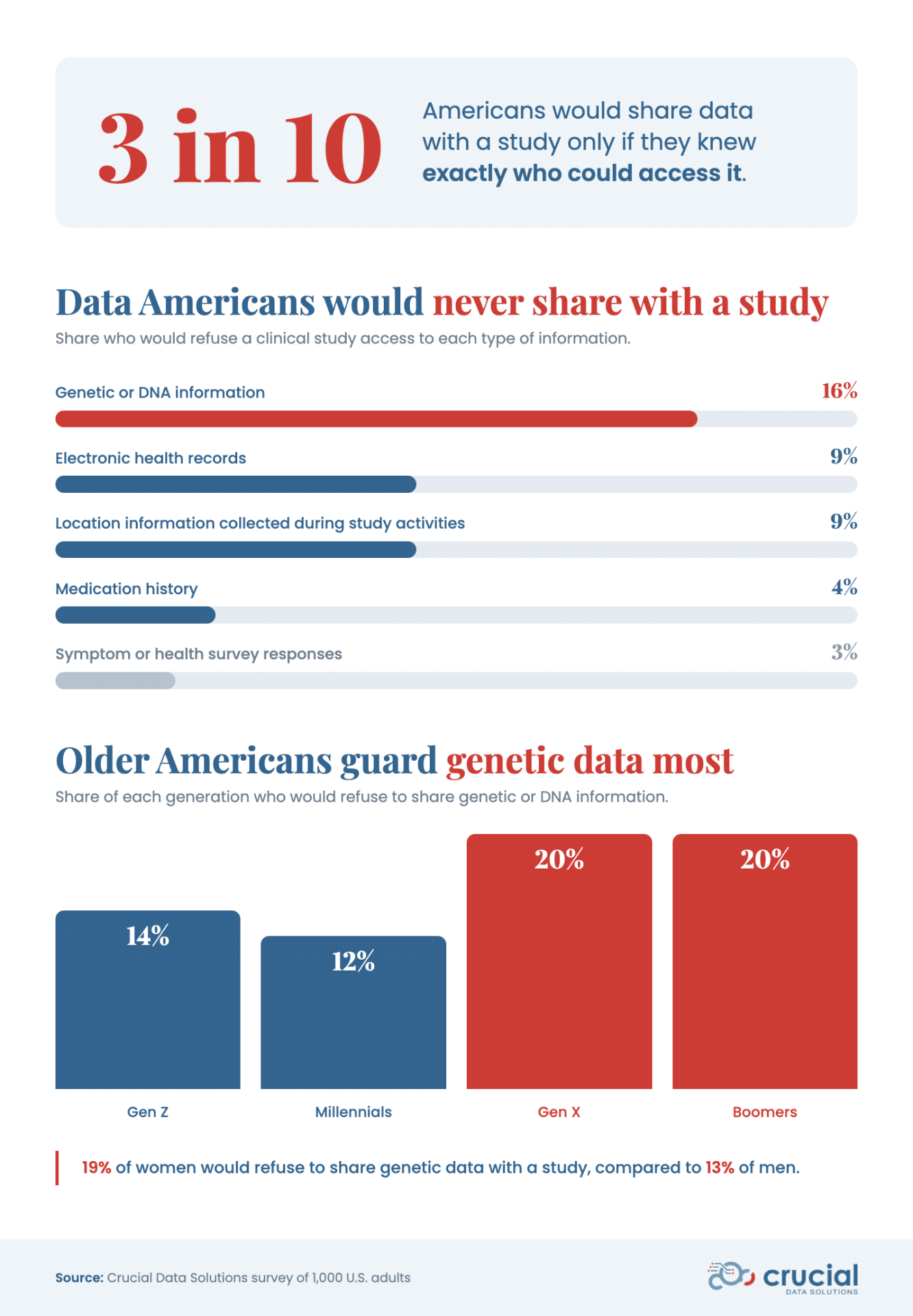
Americans said that these were the types of data they’d never release to a research team:
- Genetic or DNA information (16%);
- Electronic health records (9%);
- Location information collected during study activities (9%);
- Medication history (4%);
- Symptom or health survey responses (3%).
Others are more trusting. Over a quarter (27%) of Americans would allow access to their data with no conditions, while another 30% would only release their information if they knew exactly which organizations would have access to it.
Older participants were more protective of their information. Gen X and boomers would refuse to share genetic information at 20% each, against 14% of Gen Z and 12% of millennials. The trend held for electronic health records, as well: 14% of boomers and 11% of Gen X would refuse to share, compared to 6% each of Gen Z and millennials. Younger respondents were generally more willing to share these types of information, while older respondents reported higher refusal rates.
Similarly, women were less willing to part with their private health data. While 19% of women would refuse to share any genetic data, only 13% of men agreed. Genetic data is the only category on this list that isn’t just about the enrollee. A genome reveals information about parents, siblings, and children. The clinical stakes of what it reveals – carrier status, hereditary cancer risk, anything bearing on a future pregnancy – can change how a woman is treated not only through the trial, but in their own doctor’s office.
The Silence After the Study
When a trial ends, many research teams never circle back to the people who took part. In a large survey of clinical trial authors published in BMJ Open, only a minority reported sharing results with their participants, and relatively few said a funder or ethics board had even suggested it. Participants want to know what their time went toward, and those who never hear back may think twice before volunteering again.
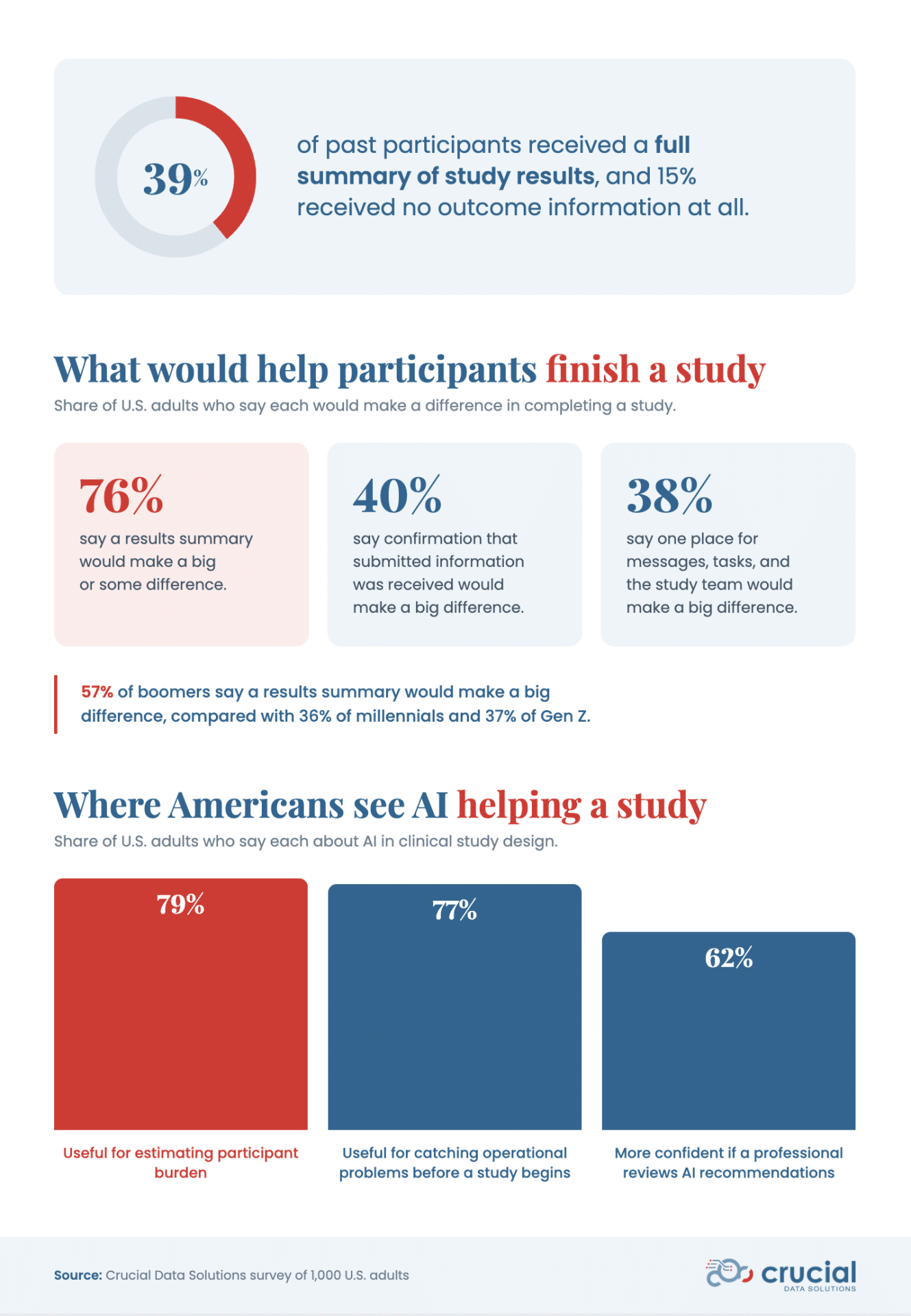
Experiences with post-study communication varied considerably. Among those who had completed a trial in the past, just 39% received a full summary of the results, and 15% received nothing about the outcome at all. Meanwhile, 76% of Americans said a results summary would make a big or some difference in helping them complete a study.
Others wanted more communication during the trial itself. Confirmation that submitted information was received would make a big difference for 40%, and having one place to receive messages, complete tasks, and reach the study team would do the same for 38%. Participants want to know their contribution was seen, and want one place to confirm.
Boomers were most passionate about receiving trial results. A majority (57%) said a summary would make a big difference in helping them complete a study, compared with 36% of millennials and 37% of Gen Z. Women valued a single point of contact more than men did: 42% called it a major plus, compared with 33% of men.
Participants give a study their time and sometimes their genome. A share of them hear nothing back. Closing that gap doesn’t take a breakthrough. It takes budgeting for the end of a study the way sponsors budget for the start of one.
A Role for AI in Study Planning
Long before anyone enrolls, research teams decide how much a study will ask of its volunteers and work out the logistics that keep it running. Americans see AI as a potential tool for that planning work.
Respondents rated AI tools useful for estimating participant burden (79%) and for catching operational problems before a study begins (77%). However, they also want to know that a human will read the AI results. Knowing a trained professional reviews AI recommendations would increase confidence in a study for 62% of Americans. Boomers weighted it most heavily, with 33% saying it would greatly increase their confidence.
What the Volunteer Pool Is Waiting For
Recruitment gets treated as a persuasion problem. Messaging and awareness campaigns dominate the standard toolkit, all of it built on the assumption that the public needs convincing. What Americans describe is closer to an architecture problem. The constraints they name live inside the protocol document — how far, how often, how long, and whether any of it can happen from a kitchen table. Those are decisions someone makes before a single site opens its doors.
The cost of getting it wrong lands unevenly. A study built around frequent daytime visits to a single urban site selects for people with flexible schedules and short commutes, and it quietly excludes everyone else. That shapes more than an enrollment timeline. Who ends up in a trial determines who the resulting evidence actually describes, and a therapy validated on a narrow slice of the population carries that narrowness into every prescription written afterward. The fix isn’t to move everything online, either — preferences split sharply by age and circumstance, and a fully remote default would trade one excluded group for another.
Flexibility is what people really need, and none of it waits on a technical breakthrough. Remote data capture and televisit infrastructure already exist and already work. What lags is the willingness to write them into a protocol at the design stage rather than bolting them on after enrollment stalls, and to treat what happens after the last visit as part of the study rather than a courtesy. For many potential research volunteers, willingness may already be there. What they need is a study that fits around a Tuesday.
Methodology
Crucial Data Solutions surveyed 1,000 U.S. adults aged 18 and older using a nationally balanced sample. Respondents were given a definition of ‘clinical research study’ before the first question to ensure a consistent baseline understanding. The survey examined participation history, motivations and deterrents, logistical barriers, study format and scheduling preferences, technology and wearable readiness, data privacy preferences, communication habits, and attitudes toward AI in study design. Results were analyzed and stratified across demographic segments including generation (Gen Z, millennials, Gen X, Baby boomers), gender, household income, employment status, and region, supplied through standard panel-profile variables. Percentages reflect self-reported data and may sum to more than 100% when multiple selections were allowed.
About Crucial Data Solutions
Crucial Data Solutions develops TrialKit, a unified eClinical platform that sponsors, CROs, and research institutions use to design, build, manage, and analyze clinical trials and non-interventional studies from startup through closeout. Available via web, native iOS and Android apps, and macOS, TrialKit supports site-based, hybrid, and decentralized study designs, with integrated data capture, participant-facing tools, study management capabilities, and built-in intelligence in a single environment.
TrialKit’s AI model, Floyd, extends that intelligence across the study lifecycle, supporting teams with protocol design, study building and validation, simulation, and data analysis. Founded in 2010 and headquartered in Reno, Nevada, Crucial Data Solutions develops technology to help research teams address operational challenges like those highlighted in this research.
Fair Use Statement
The findings and graphics in this article are available for noncommercial use. If you share them, please credit Crucial Data Solutions and include a link back to this original research so readers can access the full study.
This article was last updated November 11, 2026