Why the TrialKit Platform License Agreement Changes the Economics of Clinical Trials
In the clinical trial technology market, pricing models can influence client relationships as much as product capabilities. For sponsors and research organizations, one persistent challenge arises after a proposal is executed. Scope adjustments, protocol amendments, and mid-study modifications frequently trigger change orders that introduce additional fees. These costs can disrupt forecasting, slow operational decisions, and create friction within otherwise productive partnerships.
Crucial Data Solutions (CDS) designed the TrialKit platform to address this structural issue directly.
The Limitations of Proposal-Based Pricing
Many clinical technology vendors operate under project-based commercial frameworks. At study initiation, a proposal outlines defined deliverables, timelines, and pricing. While comprehensive at the outset, the model is based on assumptions about study design and anticipated operational needs at a single point in time.
However, clinical research evolves over the life of a study. Protocol amendments, additional sites, revised endpoints, expanded data collection requirements, and regulatory-driven updates are routine. Under traditional billing structures, these changes often require formal change orders. In addition to incremental fees, change orders may introduce internal review cycles, revised purchase orders, procurement reapproval processes, and contract amendments. Database updates and configuration changes can become dependent on commercial renegotiation timelines rather than operational urgency.
This dynamic introduces financial and procedural variability into an already complex environment.
A Platform-Centered Commercial Model
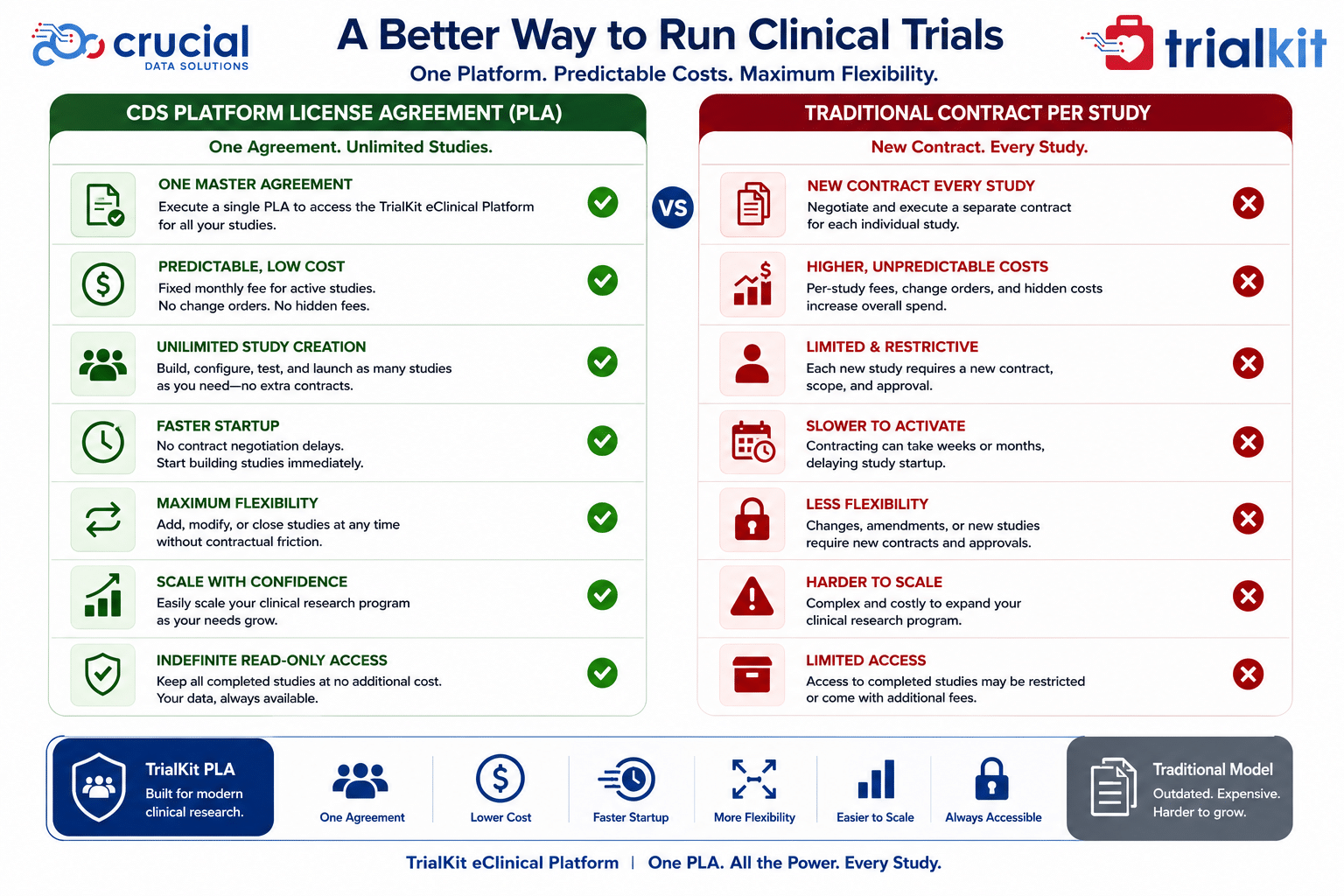
TrialKit operates under a Platform License Agreement (PLA), designed to align commercial terms with the realities of adaptive clinical research.
Under the PLA:
- Sponsors pay a consistent monthly subscription for live studies
- The pricing structure is transparent
- The effective rate per study decreases as the number of concurrent live studies increases
- Routine study modifications do not generate incremental change order fees
The monthly subscription remains stable despite typical mid-study adjustments. As organizations expand their portfolio within the platform, economies of scale emerge at the portfolio level.
The commercial structure is centered on sustained platform access rather than deliverable-based billing.
Operational Autonomy Through Self-Provisioning
A central component of the TrialKit model is user-level configurability. Sponsors and CROs can provision and manage studies directly within the platform without requiring vendor-mediated scope revisions.
Within TrialKit, teams can:
- Build and configure study databases directly
- Implement protocol amendments and mid-study edits
- Adjust forms, workflows, and user roles
- Clone studies and manage version control
Because pricing is not tied to granular configuration requests, operational decisions proceed independently of contract modifications. The PLA governs the broader commercial relationship, allowing study teams to respond to real-world conditions without incurring financial consequences tied to routine changes.
In practical terms, this supports faster amendment implementation, more responsive database updates, and reduced dependency on procurement cycles.
Eliminating Structural Change Order Exposure
Change orders are a common feature of many clinical technology engagements. The PLA framework removes exposure to incremental change orders associated with routine study evolution.
Commercial terms are defined at the outset and remain stable throughout the study lifecycle. As a result:
- Standard study adjustments do not produce unexpected invoices
- Protocol refinements do not result in penalty fees
- Contract amendments are not required for routine operational updates
This approach supports budget continuity while preserving study flexibility.
Predictability, Scalability, and Long-Term Alignment
The PLA model supports a portfolio-oriented approach to clinical technology adoption. Organizations can scale their use of TrialKit with defined financial parameters:
- Monthly costs are forecastable
- Per-study economics improve as study volume increases
- Procurement processes are simplified
- Vendor governance becomes more straightforward
By aligning commercial structure with operational autonomy, CDS supports sustained platform relationships across multiple studies and therapeutic areas.
A Commercial Framework Aligned with Modern Trials
Clinical research continues to grow in complexity, data volume, and regulatory scrutiny. Commercial frameworks built on static study assumptions no longer reflect how trials are actually conducted. Sponsors require financial frameworks that account for amendment frequency, evolving endpoints, and iterative study design.
The TrialKit Platform License Agreement provides a commercial structure built on defined terms, operational flexibility, and portfolio-level efficiency. A stable pricing foundation enables sponsors and research organizations to focus on execution, regulatory compliance, and study outcomes without repeated contract renegotiation.
For more information, contact us today.